Hardkernel ODROID-X for $129

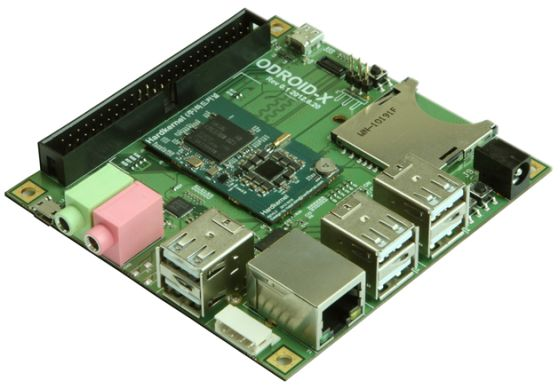
Did I miss the miniaturization memo? After waiting for months, last month I was finally able to order a Raspberry Pi for $35.00 USD. Now Hardkernel (Korean company) is offering a premium board called ODROID-X for $129.00 USD. Yes, it is more money but you get a quad-core ARM CPU and 4 times the amount of RAM!!!
Hardkernel ODROID-X
The Hardkernel ODROID-X has:
– 1.4 GHz Exynos 4412 quad-core ARM Cortex-A9 CPU
– 1GB of RAM
– Mali 400 graphics
– 6 USB 2.0 ports (Yes, 6 ports!!)
– 10/100Mbps Ethernet
– Microphone and headphone jacks
– Full-sized SDHC card slot

It can run both Ubuntu Linux and Android.

I am REALLY tempted to order one (even though I ordered a Raspberry Pi). I just need to come up with a reason. 🙂 Oh, I know: Canada has long cold winters. 🙂

Regards,
Roger Lacroix
Capitalware Inc.

Linux, Open Source Comments Off on Hardkernel ODROID-X for $129

Life After a PC

Robert X. Cringely has an interesting perspective of the PC era:
http://www.cringely.com/2012/06/30/life-personal-computer/

If you extrapolate Robert’s thoughts to other computing environments then you would say:

– The mainframe is dead – long gone buried. Oh wait, it lives and is doing very well.

– The super-computer is dead. Well, it almost died but with Linux transplanted as the OS of choice (over 90% of super computers use Linux), it is doing very well.

– The mid-range computer is dead. Oh wait, Unix is doing very well.

Mainframes, super computers and mid-range computers are not ‘every person’ computers, so they will not fit the standard consumer model that Robert is referencing.

Now there are 3 operating systems (OS) that I think are getting boxed into a corner with few options: Windows, Solaris and HP-UX.

– HP-UX is running on a CPU (Intel Itanium) that is not leading edge technology and is outdated. Most companies are switching to Linux, so that they can run an OS on the latest CPUs from Intel and AMD.

– Solaris spent too long going nowhere when Sun was going down hill. Now Oracle has Solaris, but nobody seems to care – its not like the dot com days. Plus Oracle expects premium dollars for things they sell, so it makes the decision between Solaris and Linux very easy.

– Windows has 90% of the desktop market, a modest server market and next to nothing for the mobile market. A few years ago, the gurus said that the world was going to be ruled by ‘NetBooks’ and then along came the iPad and Android tablets and the switch was astonishing and fast. Consumers are using their smart-phones and tablets as computers and not bothering to get a desktop PC or laptop (or NetBook). This will have a dramatic effect on Microsoft.

So, what do I see for the future?

– HP-UX will need to switch to a new CPU sooner rather than later but even if they do switch, HP-UX days are numbered. Oracle has stopped supporting their DB on HP-UX and other companies are also stopping support of their products on HP-UX. So, HP-UX’s days are numbered.

– Solaris will eventually die because there is nothing compelling about it but because Oracle has deep pockets, it will take a long time. Plus Oracle is now doing the Microsoft bundling strategy of selling both Solaris and Oracle DB and/or WebLogic to try and keep Solaris relevant. It should work for a while but not forever.

– Windows will be the king of desktop PCs and laptops for a long time to come but the real gotcha is that consumers will stop buying desktops and laptops and instead buy newer, more powerful smart-phones and tablets. Also, Microsoft’s Windows 8 tablet strategy is just weird. There will be 2 different Windows 8 tablets: Intel and ARM. If you buy a Windows 8 ARM tablet, you cannot use ‘apps’ build for Windows 8 Intel tablet. This is going to drive people crazy (and developers too).

The winner is going to the kings of the smart-phone and/or tablet market and right now that is iOS (Apple) and Android (which is what Robert highlighted in his article). Both iOS and Android are ‘first-movers’ in the smart-phone and tablet markets and have established both themselves and what is expected of the device. Will Windows 8 or BlackBerry 10 make a difference in the smart-phone or tablet market, I don’t think so. They will be niche players as Microsoft does not understand (or does not want to understand) the mobile market and RIM is so late with BlackBerry 10 that it is totally irrelevant now.

I think there will be another surprise winner in years to come: Google’s ChromeBook. ChromeBook appears to be that holy-grail ‘thin-client’ that actually functions the way that consumers want. So, I am pretty sure that businesses will start to seriously think of replacing laptops (and possibly desktops) with ChromeBooks. If they do, Microsoft is in for a world of hurt.

That’s my 2 cents.

Regards,
Roger Lacroix
Capitalware Inc.

iPhone, iPad & iPod Touch, Linux, Operating Systems, Unix, Windows, z/OS 1 Comment

A Software Architect

Chris Eppstein has a great view of a Software Architect:
http://coderwall.com/p/lbda2q

Food for thought. 🙂

Regards,
Roger Lacroix
Capitalware Inc.
Education, Programming Comments Off on A Software Architect

WMQ v7.0.1.8 Java/JMS Application Leaks Connections

IBM has the following APAR IC79103 for the fix:
http://www.ibm.com/support/docview.wss?uid=swg1IV18624

Error Description:
Applications using the WebSphere MQ classes for Java Version 7.0.1.8 repeatedly reconnect and finally consume all the available connections of the queue manager.

Traces show repeated occurrences of completion code “2” and reason code “2009”, and internal exceptions are traced out containing the following callstack:

Throwing Exception: com.ibm.mq.jmqi.JmqiException: CC=2;RC=2009
com.ibm.mq.jmqi.remote.internal.RemoteHconn.getConnection (RemoteHconn.java:855)
com.ibm.mq.jmqi.remote.internal.RemoteHconn.isSPISupported (RemoteHconn.java:3608)
com.ibm.mq.jmqi.remote.internal.RemoteFAP.jmqiPutMessageWithProp s(RemoteFAP.java:7495)

Regards,
Roger Lacroix
Capitalware Inc.

IBM i (OS/400), IBM MQ, Java, JMS, Linux, Programming, Unix, Windows, z/OS Comments Off on WMQ v7.0.1.8 Java/JMS Application Leaks Connections

Stanford’s Top Major Is Now Computer Science

Interesting how things change/evolve:
http://www.theatlantic.com/technology/archive/2012/06/stanfords-top-major-is-now-computer-science/259199/

Regards,
Roger Lacroix
Capitalware Inc.

Education Comments Off on Stanford’s Top Major Is Now Computer Science

amqrmppa on AIX Leaks Memory When using a Security Exit

If you use a security exit with WMQ v7 on AIX, the amqrmppa process has a bug that causes it to leak memory. When the security exit accepts/allows a connection, about 0.24KB of memory per connection is leaked. When the security exit rejects a connection, about 0.61KB of memory per connection is leaked.

IBM has the following APAR IV10032 for the fix:
http://www.ibm.com/support/docview.wss?rs=171&uid=swg1IV10032

Regards,
Roger Lacroix
Capitalware Inc.

Capitalware, IBM MQ, Security, Unix Comments Off on amqrmppa on AIX Leaks Memory When using a Security Exit

Stupid Security Mistakes

Josh Fruhlinger writes about stupid security mistakes:
http://www.itbusiness.ca/it/client/en/cdn/News.asp?id=67860

Food for thought. 🙂

Regards,
Roger Lacroix
Capitalware Inc.

Security Comments Off on Stupid Security Mistakes

Eclipse 4.2 Released

Eclipse Foundation has just released 72 projects including Eclipse v4.2 (‘Juno’).
http://www.eclipse.org

Highlights
– Code Recommenders is a new project that makes Eclipse code completion a lot smarter.
– Eclipse Virgo ships the new Nano kernel that provides the ability to build very small OSGi based applications.
– Koneki project delivers a Lua IDE
– Xtext has added support for integrated debugging of JVM-based DSLs created using Xtext
– Eclipse Equinox ships the reference implementation of the new OSGi R5 specifications.

Eclipse is an open source community, whose projects are focused on building an open development platform comprised of extensible frameworks, tools and runtimes for building, deploying and managing software across the lifecycle. The Eclipse Foundation is a not-for-profit, member supported corporation that hosts the Eclipse projects and helps cultivate both an open source community and an ecosystem of complementary products and services.

Regards,
Roger Lacroix
Capitalware Inc.

Java, Linux, macOS (Mac OS X), Open Source, Programming, Windows Comments Off on Eclipse 4.2 Released

New: MQ File Mover v4.1.1

Capitalware is pleased to announce the release of MQ File Mover v4.1.1. It is a free open source project.

MQ File Mover is a managed file transfer solution that facilitates the transfer of files using IBM’s WebSphere MQ (aka MQSeries). MQFM processes “Action” commands which are controlled through an MQFM Workflow XML file. The user combines a series of Action commands to create the MQFM Workflow XML file.

    Changes:

  • Fixed a bug with Archiving files when the file is greater than 4190000 bytes
  • Fixed a bug with exception handling for Receive Action when directory does not exist

For more information on MQ File Mover, please go to:
http://www.capitalware.biz/mqfm_overview.html

Regards,
Roger Lacroix
Capitalware Inc.

Capitalware, IBM i (OS/400), IBM MQ, Java, Linux, macOS (Mac OS X), MQ File Mover, Open Source, Unix, Windows Comments Off on New: MQ File Mover v4.1.1

New: MQ Visual Edit v1.6.1

Capitalware Inc. would like to announce the official release of MQ Visual Edit v1.6.1. This is a FREE upgrade for ALL licensed users of MQ Visual Edit. MQ Visual Edit allows users to view, manipulate and manage messages in a queue of a WebSphere MQ (formally MQSeries) queue manager and presents the data in a simplified format similar to a database utility or spreadsheet program.

For more information about MQ Visual Edit go to:
https://www.capitalware.com/mqve_overview.html

    Changes for MQ Visual Edit v1.6.1:

  • Fixed a bug with Open Queue List Dialog when started in a separate JVM
  • Updated docs (English only)

Regards,
Roger Lacroix
Capitalware Inc.

Capitalware, IBM MQ, Java, Linux, macOS (Mac OS X), MQ Visual Edit, Unix, Windows Comments Off on New: MQ Visual Edit v1.6.1